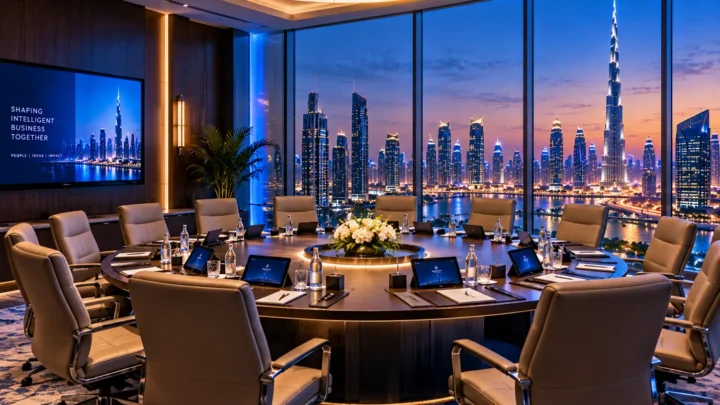
Planning AI events 2027? The teams that get most value will build a focused calendar rather than chasing every launch: pick a small number of events aligned to your roadmap, spread them across the year and send the right people to each. AirSwipe Global’s 2027 series runs roughly one focused event every three months, starting in Dubai in March.
This guide explains how to build a year-long events plan, what each city in the AirSwipe series covers and how to decide where your budget and time should go.
How to plan your AI events 2027 calendar
Many organisations approach events reactively: an invitation arrives, someone attends, and the insight stays with one person. A planned calendar turns events into a deliberate learning programme tied to your AI strategy.
Keep the calendar realistic. Senior leaders rarely have time for more than a handful of events a year, so each one needs a clear purpose and a named owner.
Start with your roadmap. If you are moving pilots into production in the first half of the year, prioritise events on architecture, cost and infrastructure early. If agent deployments and governance dominate later, plan accordingly.
- List your 2027 AI priorities by quarter, for example architecture, infrastructure, agents and resilience.
- Match each priority to one focused event rather than several broad ones.
- Assign owners who will attend and bring insights back.
- Agree a reporting format so every event produces a short, comparable briefing.
- Review the plan mid-year and adjust as priorities shift.
The AirSwipe Global 2027 series at a glance
AirSwipe Global runs focused, in-person events for senior technology leaders, each built around a single theme. The current schedule, as listed on the Events page, is below.
| City | Timing | Theme | Best suited to |
|---|---|---|---|
| Dubai, UAE | 17–18 March 2027 | Enterprise Private AI UAE 2027: Cloud, On-Prem & Edge Architecture | Leaders deciding where AI runs and how to keep data control |
| Singapore | Q2 2027 | AI Infrastructure at Asian Scale | Infrastructure and platform teams scaling across Asian markets |
| London | Q3 2027 | Agentic AI in Financial Services | Banking, insurance and payments leaders deploying agents |
| Sydney | Q4 2027 | Frontier AI and Cyber Resilience | Security and resilience leaders preparing for advanced AI risk |
| New York | Q1 2028 | The Autonomous Enterprise | Executives redesigning operating models around autonomous systems |
Each event is deliberately narrow. Rather than covering every AI topic at once, the agenda goes deep on one set of problems, so delegates spend less time in sessions that do not apply to them and more time with peers working on the same challenges. In Dubai, for example, the room is curated to 150–200 senior delegates, so conversations start at a practical level.
Timings beyond Dubai are listed by quarter, so check the events page for the latest details.
Match each event to a stage of your AI roadmap
The series follows a progression that mirrors how many enterprises mature with AI, from foundations to scale to autonomy.
Foundations: where AI runs (Dubai)
Early in the year the key questions are architectural. Which workloads belong in public cloud, private cloud, on-prem or at the edge? What should you own and what should you rent? These decisions underpin everything else, which is why Dubai opens the series.
Scale: infrastructure (Singapore)
Once architecture is set, attention turns to capacity, cost and multi-market operations. Our guide to AI infrastructure cost optimisation is useful preparation.
Autonomy: agents in regulated sectors (London)
Agentic AI raises new questions about identity, permissions and oversight, and financial services tends to feel them first. Read agentic AI governance for enterprises for background.
Resilience and transformation (Sydney and New York)
Later events address what happens when things fail and how operating models change as autonomy grows. Our piece on AI resilience when models, clouds or APIs fail is a good primer.
Budgeting and team rotation across the year
A planned calendar makes budgeting easier. Instead of approving events one at a time, you can request a single annual allocation with clear objectives for each event.
- Rotate attendees so expertise spreads across the team rather than concentrating in one person.
- Pair senior and hands-on staff at technical events so strategy and implementation perspectives are both captured.
- Use group passes where several colleagues attend, to simplify invoicing.
- Book early where early-bird pricing is offered, and track deadlines in your plan.
- Include travel and time costs so approvals reflect the full investment.
Regional relevance matters as well. Teams in the Middle East, Asia, Europe, Australia and North America may each choose the event closest to their market, while global teams can use the series to compare regional approaches to the same problems.
Formats to look for in any 2027 AI event
Whichever events you choose, the format determines how much value you take home. Large expo-style gatherings are good for breadth; focused summits are better for decisions.
- Curated audiences of senior practitioners, so conversations stay relevant
- CXO roundtables and panels that encourage candid discussion of trade-offs
- Architecture deep dives and labs that go beyond product messaging
- Structured networking, such as curated introductions, rather than leaving it to chance
- A single clear theme, so every session connects to the same set of problems
Be wary of events with vague agendas or unclear audience profiles. Ask organisers who attends and how sessions are curated before you commit. For a closer look at the region, see our guide to Dubai AI events in 2027.
Making the case internally
Once your calendar is drafted, present it to leadership as a single plan. Show the priority each event supports, who will attend, the expected outputs and the total cost. A one-page view is far easier to approve than a stream of separate requests.
After each event, add the briefing to a shared library. By the end of the year you will have a structured record of what peers are doing, which vendors you have assessed and how your thinking has evolved.
Start your 2027 at Enterprise Private AI UAE in Dubai
The series opens with Enterprise Private AI UAE 2027: Cloud, On-Prem & Edge Architecture on 17–18 March 2027 in Dubai, a two-day summit for 150–200 CTOs, CIOs, CISOs and heads of AI, data and cloud. Day 1 tackles the core question in the Keynote: Enterprise Private AI in 2027: Where Should AI Actually Run?, and Day 2 ends with the Closing Keynote: The Enterprise Private AI Playbook for 2027, a practical starting point for the rest of your calendar. Expect speakers from organisations including Microsoft, Accenture, KPMG, Infosys and Capgemini. See the agenda, review pass options, or explore all AirSwipe Global events.
Frequently asked questions
What are the key AI events in 2027 for enterprise leaders?
The most useful AI events in 2027 are focused summits that match your roadmap. AirSwipe Global's series covers private AI in Dubai, infrastructure in Singapore, agentic AI in financial services in London, cyber resilience in Sydney and the autonomous enterprise in New York.
How many AI events should my team attend in a year?
Most teams get more from a small number of focused events than from many broad ones. One event per major priority, spread across the year with a clear owner for each, is a practical starting point.
When is the AirSwipe Global AI event in Dubai?
Enterprise Private AI UAE 2027 takes place in Dubai on 17 and 18 March 2027. It is a two-day, in-person technical summit for senior technology leaders.
How do I choose between AI conferences in different cities?
Choose by theme first, then by regional relevance to your markets and teams. Check the audience profile, agenda depth and session formats before committing budget.