Zero Trust for LLMs is quickly becoming the security model of choice for enterprises that are moving generative AI into production. Large language models do not respect network perimeters: they read documents from many systems, call tools, trigger workflows and increasingly act through autonomous agents. If any of those paths is trusted by default, a single malicious prompt can turn a helpful assistant into a data-exfiltration tool.
This blueprint shows how to apply Zero Trust principles to LLM applications, retrieval-augmented generation (RAG) and AI agents, with controls mapped to the OWASP Top 10 for LLM Applications.
Why perimeter security fails for LLM applications
Traditional security assumes that what is inside the network can be trusted. LLM systems break that assumption in three ways:
- Instructions and data are mixed. A model cannot reliably tell the difference between your system prompt and text hidden inside a retrieved email or web page.
- Access is aggregated. A single assistant may be connected to email, documents, CRM and ticketing systems, giving it more reach than any individual employee.
- Actions are automated. Agents can send messages, update records or run code without a human reviewing each step.
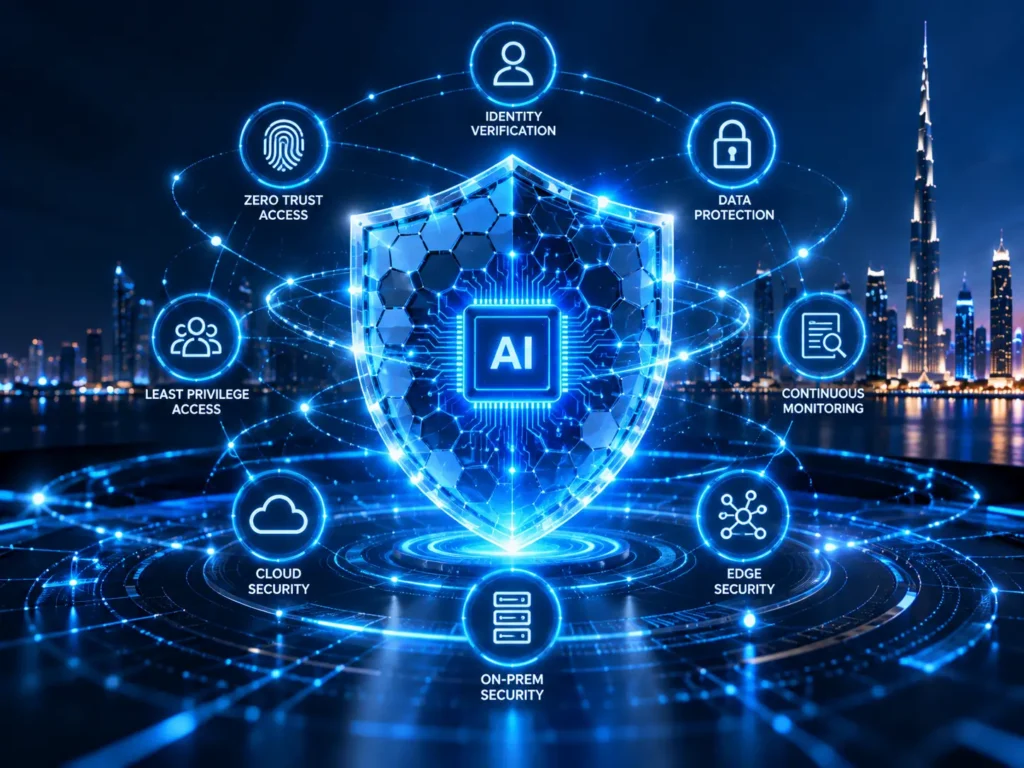
Zero Trust replaces implicit trust with explicit, per-request verification: authenticate every identity, authorise every action with least privilege, assume breach, and log everything.
The five trust boundaries in an enterprise LLM system
- User to application. Strong authentication (SSO and MFA), session controls and role-based access to AI features.
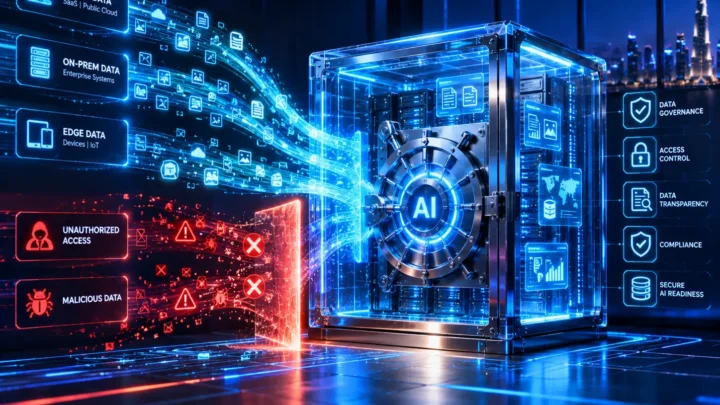
- Application to model. All model traffic goes through an AI gateway that enforces identity, policy, redaction, rate limits and logging, whether the model runs in a sovereign cloud, private cloud or on-prem.
- Model to data. Retrieval is permission-aware, vector stores are access-controlled, and sensitive fields are masked before they reach the prompt.
- Model to tools and agents. Every tool call is authorised against the agent’s own identity and scope, with human approval for high-impact actions.
- Model to logs and outputs. Prompts and outputs are logged securely, retained according to policy, and checked before they are rendered or passed to other systems.
OWASP Top 10 for LLM Applications mapped to Zero Trust controls
The OWASP Top 10 for LLM Applications (2025) is the most widely used checklist of LLM-specific risks. The table maps each risk to a practical Zero Trust control.
| OWASP risk (2025) | Zero Trust control |
|---|---|
| LLM01 Prompt Injection | Treat all retrieved and user content as untrusted; isolate system instructions; limit what the model can reach and do |
| LLM02 Sensitive Information Disclosure | Permission-aware retrieval, output filtering and redaction at the gateway |
| LLM03 Supply Chain | Approved model registry, signed artefacts and vetted third-party plugins |
| LLM04 Data and Model Poisoning | Controlled, versioned training and RAG sources with change approval |
| LLM05 Improper Output Handling | Validate and encode outputs before they reach browsers, databases or code execution |
| LLM06 Excessive Agency | Least-privilege tool scopes, short-lived credentials and human approval for risky actions |
| LLM07 System Prompt Leakage | Keep secrets out of prompts; enforce rules in code, not in prompt text |
| LLM08 Vector and Embedding Weaknesses | Access control and tenant isolation in vector stores; encrypt embeddings at rest |
| LLM09 Misinformation | Grounding with cited sources, confidence signals and human review for high-stakes answers |
| LLM10 Unbounded Consumption | Per-identity quotas, rate limits and cost alerts at the gateway |
Identity for AI agents
As agents take on real work, they need to be treated as first-class, non-human identities:
- Give each agent its own identity rather than letting it borrow a human’s full permissions.
- Issue short-lived, narrowly scoped tokens for each task, and revoke them automatically when the task ends.
- Define which tools each agent may call and with which parameters.
- Require human approval for actions that move money, change access, delete data or contact customers.
- Record the full chain: which human started the task, which agent acted, which tools were called and what changed.
Least-privilege retrieval: securing RAG
The most common real-world RAG failure is not a sophisticated attack. It is a user receiving an answer built from documents they were never allowed to open. Prevent it by:
- Enforcing the source system’s permissions at query time, not just at indexing time.
- Separating indexes by sensitivity or tenant when permissions are complex.
- Protecting vector stores with the same controls as the databases they summarise.
- Showing users the sources behind each answer so mistakes are visible.
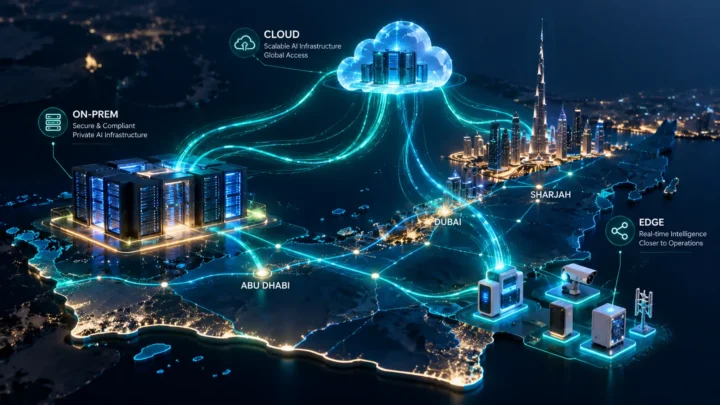
Data control also depends on where these components run. Our guide to private AI in the UAE covers workload placement across sovereign cloud, private cloud, on-prem and edge.
A 90-day Zero Trust for LLMs roadmap
- Days 1–30: Visibility. Inventory every LLM, AI feature, agent and API key in use. Route model traffic through a single gateway and start logging.
- Days 31–60: Control. Enforce SSO, role-based access and per-identity quotas. Make retrieval permission-aware. Add redaction for regulated data.
- Days 61–90: Assurance. Give agents their own identities and scopes, add approval steps for high-impact actions, run prompt-injection red-team tests and report risk alongside usage and cost.
Learn from security leaders in Dubai
Securing LLMs across hybrid enterprise environments is a dedicated technical keynote at Enterprise Private AI UAE 2027, alongside sessions on data control beyond the model and the CXO roundtable on who owns enterprise AI. Join CISOs, CTOs and AI leaders in Dubai on 17–18 March 2027. See the programme or reserve your pass.
Frequently asked questions
What is Zero Trust for LLMs?
Zero Trust for LLMs applies the "never trust, always verify" principle to AI systems. Every user, application, AI agent, tool call and retrieved document is authenticated and authorised for each request, given least-privilege access, and logged, instead of being trusted because it sits inside the corporate network.
What is the biggest security risk for enterprise LLMs?
Prompt injection is ranked first (LLM01) in the OWASP Top 10 for LLM Applications 2025. It becomes most dangerous when a model can retrieve sensitive data or call tools, which is why Zero Trust focuses on limiting what the model and its agents are allowed to reach.
How do you secure RAG systems?
Enforce document-level permissions at query time so retrieval only returns content the requesting user may access, protect vector stores like any other sensitive database, redact sensitive fields before indexing where possible, and log which sources were used for each answer.
Do AI agents need separate identities?
Yes. Each agent should have its own non-human identity with short-lived, narrowly scoped credentials, so its actions can be limited, monitored and revoked independently of the human who started it.