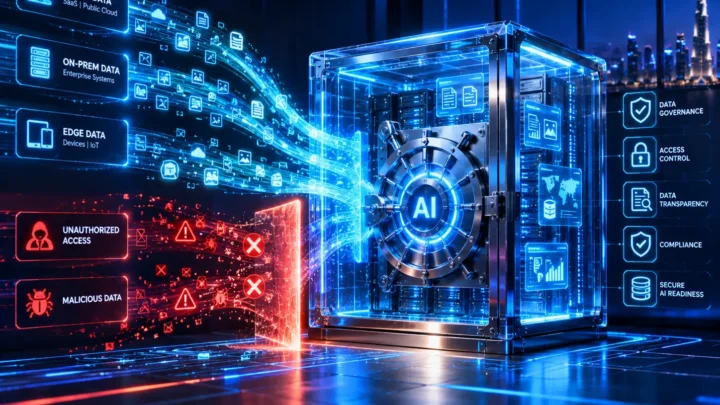
RAG security is the discipline of making sure a retrieval-augmented generation system only retrieves, embeds and reveals what each user is entitled to see. The vector database is the centre of that problem, because it often holds a searchable copy of an organisation’s most sensitive documents. Protecting it means combining query-time access control, controlled ingestion, encryption, isolation and monitoring.
What is RAG security and why do vector databases need their own controls?
Retrieval-augmented generation (RAG) gives a language model access to enterprise content at query time. Documents are split into chunks, converted into embeddings (numerical representations of meaning), and stored in a vector database. When a user asks a question, the system finds the closest chunks and passes them to the model as context.
This pattern is popular because it keeps proprietary knowledge out of model weights and makes answers easier to update. The trade-off is that you have built a new search index over your data estate, often outside the permission systems that originally protected it. A file share may restrict a board paper to six people, yet the same paper, once chunked and embedded, may be retrievable by anyone who can query the assistant.
Many organisations focus on securing the model and overlook the retrieval layer. For a wider view of how data escapes through AI systems, see our guide to LLM data leakage in logs, caches and embeddings.
Where are the main attack surfaces in a RAG pipeline?
A RAG pipeline has more moving parts than a typical application database. Each stage creates its own exposure.
- Ingestion: connectors pull content from document stores, wikis, ticketing tools and email. A over-privileged connector can index material the assistant should never see.
- Embedding generation: text is sent to an embedding model. If that model is an external API, the content leaves your boundary at this step.
- Vector store: holds embeddings plus the original chunk text and metadata. It is frequently deployed with weak defaults during pilots and never hardened.
- Retrieval and prompt assembly: returned chunks are placed into the prompt. Anything in a chunk, including hostile instructions, reaches the model.
- Outputs, logs and caches: prompts containing retrieved text are often logged, cached or sent to observability tools.
The practical lesson is that protecting the database alone is not enough. You need controls at every handoff, and a clear owner for each.
Can embeddings be reversed to reveal the original text?
Partly, yes, and leaders should plan on that basis. Embeddings are not encrypted text, and published research has shown that attackers with access to vectors and the embedding model can sometimes reconstruct meaningful information about the source content. How much leaks depends on the model, the chunk size and the attacker’s access, so no general guarantee can be offered.
Even without reconstruction, embeddings reveal relationships. An attacker can run similarity queries to test whether a particular topic, name or project exists in the corpus. That is a form of inference attack, and it matters for confidential matters such as mergers, investigations or customer cases.
The safe policy is simple: classify embeddings at the same level as their source documents. If the source is restricted, the vectors, the chunk text and the metadata are restricted too.
How should access control work in a RAG system?
The most common failure is checking permissions once, at ingestion, and never again. Permissions change, people move roles and groups are reorganised. The retrieval layer must enforce the identity of the person or agent making the request, at the moment of the request.
Carry permissions with every chunk
Each chunk should store its source access control list, classification label, owning business unit and, where relevant, jurisdiction. These attributes become filters at query time. Without them, the vector store cannot tell a public policy from a confidential contract.
Choose the isolation pattern that fits the risk
| Pattern | How it works | Strength | Main risk |
|---|---|---|---|
| Post-retrieval filtering | Retrieve broadly, then remove chunks the user cannot see | Simple to add | Restricted content is still touched; filtering bugs expose it; can return thin results |
| Metadata pre-filtering | Apply permission filters inside the vector query | Good balance for most internal use | Depends on accurate, current metadata |
| Separate collection or index per tenant or unit | Physical or logical partitions with their own credentials | Strong isolation, easier audit | More operational overhead |
| Separate store per classification | Highly sensitive data lives in a dedicated, isolated deployment | Strongest containment and residency control | Higher cost; needs routing logic |
Most enterprises will combine these. General knowledge can sit behind metadata filters, while legal, HR or regulated data is placed in its own store with tighter network and key controls.
Treat agents as identities
When an AI agent queries a knowledge base, it should do so with a scoped identity, ideally acting on behalf of a specific user, not with a shared service account that can read everything. Our article on AI agent identity and access sets out how to design this.
How do you stop poisoned or malicious content entering the knowledge base?
A RAG system trusts what it retrieves. If an attacker, or a careless employee, places a document in an indexed location, its content can influence answers. A document might contain false policy statements, or hidden text instructing the model to ignore its rules or disclose other context. This is indirect prompt injection, where the hostile instruction arrives through data rather than through the user’s prompt.
Controls that help include:
- Index only from approved sources, and record provenance (who added it, when, from where) for every chunk.
- Restrict who can write to indexed repositories, as write access to a wiki is now influence over an AI assistant.
- Scan content for hidden text, unusual formatting and instruction-like phrases before indexing.
- Mark retrieved text as untrusted data in the prompt template, and never allow it to change system-level rules.
- Require human approval before high-impact actions that rely on retrieved content.
No single filter catches everything, so layer these with output checks and monitoring. A zero trust approach, where every component is verified and none is assumed safe, fits this problem well; see our zero trust architecture for enterprise LLMs and AI agents.
What infrastructure controls should surround the vector database?
Many vector databases arrive in pilots with open network access, shared credentials and no audit trail. Before production, apply the standards you would expect for any store of confidential records.
- Network isolation: place the store in a private network segment, with access only from approved retrieval services.
- Encryption: encrypt data at rest and in transit, with keys managed in your own key management service. Consider separate keys per classification or tenant.
- Authentication: use short-lived, scoped credentials, not long-lived shared keys embedded in code.
- Audit logging: record who queried, which chunks were returned and under which identity. Protect those logs, as they may contain sensitive text.
- Backups and snapshots: apply the same classification, retention and residency rules to backups as to the live index.
- Deletion: when a source document is removed or a right to erasure applies, the chunks and vectors must be deleted too.
For workloads where data must stay within the UAE or a specific facility, deployment location matters as much as configuration. Embedding generation, the vector store and the model should be placed with residency in mind, and the specific legal requirements should be confirmed with your legal and compliance teams. Where the strongest protection is needed, confidential AI techniques can protect data while it is being processed.
A practical RAG security checklist
- Inventory every corpus feeding an assistant, with an owner, classification and source system for each.
- Map the data flow from connector to embedding model to store to prompt, including where logs and caches are written.
- Attach permission metadata to every chunk and enforce it inside the retrieval query.
- Scope identities so that users and agents retrieve only on their own entitlements.
- Control ingestion with approved sources, provenance records and content scanning.
- Harden the store with private networking, customer-managed keys, scoped credentials and audited access.
- Red-team retrieval with adversarial queries, cross-role tests and injection attempts before go-live.
- Monitor continuously for unusual query patterns, bulk similarity probing and unexpected chunk returns.
- Test deletion and permission changes to confirm that removals reach the index promptly.
Ownership matters here. Security, data and platform teams each hold part of the pipeline, and gaps appear where nobody is accountable for the retrieval layer. Assign it explicitly.
Next steps for security and platform leaders
Start with one production or near-production assistant and run the checklist above against it. The most valuable first test is also the simplest: log in as a user with limited rights, ask questions designed to surface restricted material, and see what comes back. Most organisations find at least one gap, and finding it before an incident is the point.
Then agree a standard retrieval architecture, so that each new assistant inherits permission-aware retrieval, private deployment and audit logging, rather than rebuilding them. These retrieval design questions are among the topics for security and platform engineering leaders at Enterprise Private AI UAE 2027 in Dubai on 17–18 March 2027; the summit programme and agenda shows how the sessions are shaping up.
Frequently asked questions
What is the biggest security risk in a RAG system?
The biggest risk is usually retrieval that ignores the requesting user's permissions. Content a person could not open in its source system becomes reachable through the assistant once it is chunked and embedded. Enforcing access control at query time addresses this directly.
Are embeddings sensitive data?
Yes, they should be treated as sensitive. Embeddings are derived from source content, and research has shown that information can sometimes be partly reconstructed or inferred from them. Classify them at the same level as the documents they came from.
How do you prevent data leakage between users in a vector database?
Store permission and classification metadata with every chunk and apply it as a filter inside the retrieval query. For highly sensitive data, use separate collections or stores with their own credentials. Test with cross-role queries before launch.
Can a RAG knowledge base be poisoned?
Yes. If someone can add or edit documents in an indexed source, they can influence the model's answers or embed hostile instructions. Limit write access, record provenance, scan content before indexing and treat retrieved text as untrusted.
Does a private vector database remove the need for RAG security controls?
No. Hosting the store privately helps with residency and exposure, but it does not fix over-broad retrieval, poisoned content or leaky logs. Access control, ingestion checks and monitoring are still required.