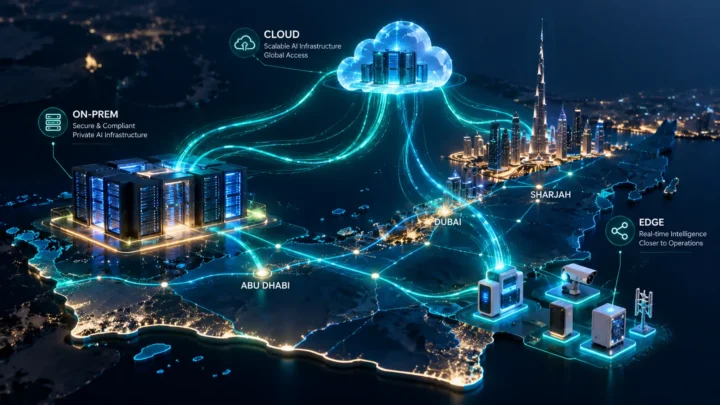
Edge AI inference means running a trained model on hardware at the plant, substation, pipeline station or wellhead, rather than sending every reading to a remote data centre. For energy, utilities and industrial operators it is worth the effort when decisions must be fast, must survive a lost network link, or involve data that should not leave the site. It is a poor fit when the workload is occasional, tolerant of delay and easier to run centrally.
Why do energy and industrial sites need inference at the edge?
Inference is the stage where a trained model produces an output from new input, such as a vibration reading or a camera frame. Training is heavy and infrequent; inference is continuous. At an industrial site, continuous inference raises three practical problems that the cloud alone does not solve.
- Latency and determinism. A round trip to a remote region adds delay and, more importantly, variable delay. Detecting a failing pump bearing can tolerate that; stopping a conveyor on a safety event cannot.
- Connectivity. Remote assets often sit behind satellite, cellular or microwave links with limited bandwidth. Streaming high-frequency sensor data or video continuously is expensive and fragile.
- Data control. Operational data can reveal production volumes, network topology and vulnerabilities. Many operators prefer that raw telemetry stays inside the site boundary.
These pressures are why the question is rarely “cloud or edge” and more often “which part of the pipeline runs where”. Our wider guide to where enterprise LLMs should run across cloud, on-prem and edge covers the general placement logic; this article applies it to operational sites.
Which workloads suit edge inference in energy and utilities?
Start with workloads where the input is high-volume, the decision is local and the cost of delay is clear. The following are common candidates.
Condition monitoring and predictive maintenance
Models that read vibration, temperature, acoustic or electrical signals can flag early signs of wear on turbines, compressors, transformers and motors. Running them locally means only events and summaries travel upstream, not raw waveforms.
Computer vision for safety and inspection
Cameras can check for missing protective equipment, intrusion into restricted zones, leaks, flare anomalies or corrosion. Video is bandwidth-heavy and often sensitive, which makes on-site processing the sensible default.
Anomaly detection on process data
Lightweight models can compare live readings against learned normal behaviour for a unit or feeder and alert operators to drift. These are usually small enough to run on modest hardware.
Language models as an operator assistant
A small or quantised language model (one compressed to use less memory and compute) can answer questions about procedures, manuals and shift logs when the site is offline. It should retrieve from a local, approved document set and stay advisory. For the trade-offs between retrieval and training on your own documents, see our comparison of fine-tuning, RAG and prompting.
Workloads that usually stay central include fleet-wide analytics, long-horizon forecasting, model training and anything that needs data from many sites at once.
What does a practical edge AI architecture look like?
A three-tier pattern works for most operators. It keeps real-time decisions close to the asset while preserving a single point of governance.
| Tier | Role | Typical workloads | Main constraint |
|---|---|---|---|
| Site edge | Real-time inference next to sensors and cameras | Anomaly detection, vision, local assistant | Power, space, heat, dust, no on-site engineers |
| Regional or private cloud | Aggregation, retraining, larger models | Fleet analytics, fine-tuning, evaluation | Link quality and data residency |
| Central platform | Governance, model registry, observability | Approvals, versioning, audit, cost control | Consistency across many sites |
Design each site to operate on its own. The edge node should keep inferring, buffering events and applying its last approved model when the uplink fails, then reconcile when connectivity returns. This is the same thinking set out in our guide to planning for model, cloud and API failures, applied to physical sites where a failure has operational consequences.
Hardware choices
Match the hardware to the model, not the other way round. Small vision and anomaly models often run on compact accelerators or ruggedised industrial PCs. Language models need more memory, so size them carefully and test under real thermal conditions. Sites in hot climates, including much of the GCC, need cooling and dust protection designed in from the start, because a throttling accelerator quietly degrades latency.
How do you secure edge AI next to operational technology?
Operational technology (OT) is the hardware and software that monitors and controls physical processes, including SCADA (supervisory control and data acquisition) systems and programmable logic controllers. Its priorities differ from corporate IT: availability and safety come first, and systems may run for years without patching.
An edge AI node bridges those worlds, so it needs deliberate boundaries.
- Segment the network. Place AI nodes in a defined zone, following your existing reference model such as the Purdue model, and permit only the specific flows each node needs. Industrial security standards such as the IEC 62443 series describe zones and conduits; confirm how they apply to your assets with your OT security team.
- Keep inference read-only by default. The model should consume data from the historian (the database that stores process time-series data) or a mirrored feed. It should not hold write access to controllers.
- Sign and verify every model update. Treat a model file like firmware. Verify provenance before loading, and keep the previous version for rollback.
- Protect the node physically. Remote cabinets are accessible. Use disk encryption, secure boot and tamper detection where the risk justifies it.
- Control what the assistant can reach. A language model with tool access is an attack surface. Apply the principles in our guides to prompt injection and data leakage before any assistant touches work orders or documents.
Should edge AI ever control equipment directly?
Treat advisory use and closed-loop control as separate programmes. An advisory model that alerts an operator can be introduced with ordinary change management. A model that adjusts setpoints or trips equipment falls under functional safety, and it needs deterministic behaviour, defined failure modes and formal sign-off from process safety engineers.
A sensible progression is to run in shadow mode first, comparing model outputs with operator decisions without acting on them. Then move to recommendations with human approval, and consider automation only for narrow, well-understood cases with independent safety layers. Models are probabilistic, so they should never be the only barrier between a fault and a hazard.
How do you manage models across hundreds of remote sites?
Most edge programmes that stall do so on operations, not accuracy. One model on one pilot site is an experiment; the same model on many sites with different sensors, firmware and local conditions is a fleet management problem. Discussion of this gap between pilot and production is a recurring theme at the Enterprise Private AI UAE 2027 summit in Dubai, where architecture and platform leaders compare how they operate distributed inference.
Build these capabilities before scaling:
- A model registry that records which version runs at which site, who approved it and what data it was evaluated on.
- Staged rollouts to a small group of sites first, with automatic rollback if error rates or alert volumes shift.
- Drift monitoring. Sensors age, seasons change and plant configurations are modified. Track input distributions and alert quality per site, not just overall.
- Local telemetry with limited upstream traffic. Send summaries and exceptions, and retain raw data locally for a defined period.
- Spare and replacement procedures that field technicians can follow without a data scientist present.
A central AI control plane gives these functions one home, so that policy, versioning and audit apply equally to cloud, on-prem and edge deployments.
What do data residency and sovereignty mean for edge deployments?
Edge inference can simplify data residency, because raw operational data is processed where it is created. It does not remove the obligation. Model updates, logs, prompts and exception data that flow back to a regional or central tier may still be in scope of national or sector rules, and energy and utilities are often treated as critical infrastructure.
Map what leaves each site, where it lands and who can access it. Confirm requirements for your sector and jurisdiction with legal and compliance teams rather than assuming that on-site processing satisfies them. Our article on sovereign AI and data residency in the UAE sets out how to approach that mapping.
Five steps before you fund a multi-site rollout
- Pick one workload with a measurable operational outcome, such as fewer unplanned stoppages on a defined asset class, and agree how you will measure it.
- Test on degraded conditions: lost uplink, high ambient temperature, noisy sensors and a failed node.
- Define the OT boundary in writing with your OT security owners, including read-only access and update signing.
- Run in shadow mode long enough to see seasonal and operational variation before any automation is discussed.
- Cost the whole fleet, including hardware refresh, field support, connectivity and monitoring, not only the pilot unit.
If you are working through these decisions, the summit programme and agenda for 17–18 March 2027 in Dubai lists the architecture sessions covering cloud, on-prem and edge. Bring your site constraints and your open questions; the most useful conversations are usually about what failed in the field, not what worked in the demo.
Frequently asked questions
What is edge AI inference?
Edge AI inference is running a trained AI model on hardware close to where data is created, such as a plant, substation or pipeline station. It lets decisions continue with low delay and without a constant connection to a remote data centre.
Which industrial workloads are best suited to edge AI?
Condition monitoring, computer vision for safety and inspection, and anomaly detection on process data are the strongest candidates. They involve high-volume inputs and local decisions. Fleet-wide analytics and model training usually stay in a regional or central tier.
Is it safe to connect edge AI to operational technology networks?
It can be, if the AI node sits in a segmented zone, has read-only access by default and receives only signed model updates. Direct write access to controllers should be avoided. Confirm the design against your OT security standards with your specialists.
Can edge AI models control equipment automatically?
Technically yes, but it should be treated as a separate, safety-engineered programme. Start with advisory use and shadow mode, then add human-approved recommendations. Models should never be the only barrier between a fault and a hazard.
Does edge inference solve data residency requirements?
Not entirely. Processing raw data on site helps, but logs, model updates and exception data sent upstream may still be in scope. Map every data flow and confirm obligations with legal and compliance teams.