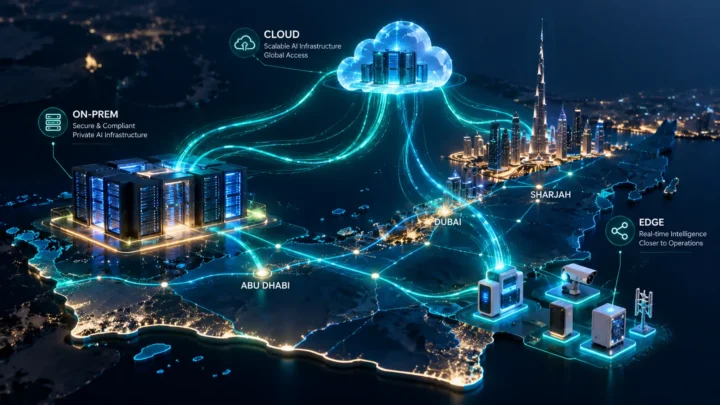
Government and public sector bodies should run private LLMs by classifying their data first, then matching each workload to a deployment tier: sovereign or on-premises infrastructure for the most sensitive material, approved in-country cloud for the rest. The architecture then adds identity, retrieval controls, audit trails and an exit plan, so that the service stays accountable to citizens and regulators. The model is the easiest part to replace; the surrounding controls are what take time to build.
Why are public sector LLM requirements different?
A large language model (LLM) is a neural network that generates text from prompts. In a bank or a retailer, an error is mostly a commercial problem. In government, the same error can affect a benefit decision, a legal notice or a citizen’s trust in an institution.
Four pressures shape the design:
- Data sensitivity. Citizen records, security information and internal policy drafts often sit under national classification rules that restrict where data can be processed and who can see it.
- Accountability. Decisions must be explainable and traceable to a responsible officer, which rules out opaque, unlogged AI behaviour.
- Procurement and continuity. Public bodies commit to platforms for years and cannot easily absorb a supplier exit or a sudden pricing change.
- Uneven maturity. Ministries, municipalities and agencies have very different engineering capacity, so a single bespoke build per entity does not scale.
For UAE and wider GCC entities, data residency and sovereignty add a further layer. Our guide to sovereign AI in the UAE and what data residency means for LLMs covers that in detail. Confirm the specific obligations that apply to your entity with legal and compliance teams, as they vary by sector and classification.
Which deployment model fits which government workload?
There is no single right answer, because workloads differ. The practical approach is to tier them by the classification of the data they touch, then choose the least restrictive environment that still satisfies the rules.
| Tier | Typical data | Suggested environment | Main trade-off |
|---|---|---|---|
| Highly sensitive | Security, intelligence, restricted policy, sensitive personal records | On-premises or air-gapped sovereign infrastructure | Highest control, but you carry hardware, staffing and refresh costs |
| Sensitive | Citizen case files, health, tax, licensing | Government or sovereign private cloud within national borders | Strong residency control, with some dependence on the cloud operator |
| Internal | Operational documents, HR, procurement, internal knowledge | Approved in-country cloud region with private networking | Faster scaling, but needs careful contract and logging review |
| Public | Published services, open data, general citizen enquiries | Managed or API-based models with strict input filtering | Lowest cost and effort, but only suitable where no sensitive data can enter |
Edge deployment, meaning inference close to where data is created, also has a place for field inspectors, border points or disconnected sites. For a wider comparison, see our piece on where enterprise LLMs should run.
What does a reference architecture for a government private LLM look like?
Think in layers, each with a clear owner. This lets different departments consume the same platform without duplicating security work.
1. Access and identity layer
Every request should carry the identity and role of the civil servant, system or agent making it. Access decisions use existing government identity services rather than a separate AI login. This is the basis of a zero trust approach, where nothing is trusted because of its network position alone.
2. Gateway and policy layer
A central gateway sits between users and models. It redacts or blocks sensitive fields, enforces which models a given classification may use, applies rate limits and records each interaction. It is the practical place to turn written policy into runtime control.
3. Model layer
Run a small set of approved models, hosted in the tier that matches the data. Smaller models fine-tuned or prompted for narrow tasks, such as summarising case notes, are often easier to host privately and to evaluate than a single large general model. Route requests to the right one rather than defaulting to the biggest.
4. Retrieval and knowledge layer
Retrieval-augmented generation (RAG) lets a model answer from approved documents instead of its training memory. It is usually the right pattern for government, because answers can cite a source and be checked. The index must respect document-level permissions, which we cover below.
5. Observability and audit layer
Capture prompts, retrieved sources, model version, outputs and reviewer actions, with retention rules set by records management policy. Without this, you cannot answer an auditor, an ombudsman or a court.
How do you stop retrieval, logs and caches becoming a leak?
Teams often secure the model and forget everything around it. A vector database, which stores numerical representations of documents (embeddings) for search, can reveal content from restricted files if permissions are not carried across. Prompt logs, caches and evaluation datasets can hold the same citizen data as the source system.
Treat each of these as a data store with the classification of its most sensitive input. Apply document-level access checks at query time, not just at indexing time. Our article on RAG security for vector databases and embeddings sets out the specific controls.
Also decide early who can read logs, how long they are kept and where they are stored. A private model with an unrestricted log pipeline is not private in any meaningful sense.
Where should humans stay in the loop?
Public bodies carry duties of fairness and explanation that a model cannot satisfy by itself. Use a simple rule: the greater the effect on an individual’s rights, money or status, the more human review is required before action.
- Low impact: drafting, translation, summarising internal documents. A user reviews the output as part of normal work.
- Medium impact: triaging citizen correspondence or flagging cases for attention. An officer confirms before any outcome is communicated.
- High impact: eligibility, enforcement or penalty decisions. The LLM may assist with evidence gathering, but a named official decides and records the reasoning.
The same logic applies to AI agents that call other systems. Give each agent its own identity, narrow permissions and a record of actions taken.
How can public bodies avoid lock-in and plan for continuity?
Government platforms outlive vendor roadmaps. Design for replacement from the first day by keeping prompts, evaluation sets, retrieval indexes and policy rules in formats you own, and by placing a gateway between applications and models so a model can be swapped without rewriting every service.
Write exit terms into contracts: data return, deletion evidence, support for model portability and clear rules on where operators and support staff are located. Our guide to avoiding AI vendor lock-in explains which layers to own and which to rent.
Continuity also means a fallback. If a hosted model or link fails, essential services should degrade to a smaller local model or a manual process, not stop.
A decision checklist for architecture review
Use these steps when a ministry or agency proposes a new LLM use case:
- Classify the data the use case will read, produce and store, including logs and indexes.
- Assign a deployment tier and confirm residency and sovereignty requirements with legal and compliance teams.
- Define the decision impact and the required level of human review.
- Route all traffic through the shared gateway with identity, redaction and logging enabled.
- Test the model on realistic, representative cases, including adversarial prompts, before any live use.
- Set retention, access and deletion rules for prompts, outputs and embeddings.
- Document the exit route and the fallback if the service is unavailable.
- Agree a named owner who is accountable for outcomes after go-live.
Next steps for public sector technology leaders
Start with an inventory rather than a model selection. List the use cases in demand, classify their data and map them to the tiers above; most organisations find that a minority need the most restrictive environment, which keeps on-premises capacity focused where it matters.
Then build one shared platform, with the gateway, identity integration and audit trail, before approving many separate pilots. Departments can then adopt LLMs faster because the hard controls already exist.
These are the questions we expect practitioners to compare notes on at Enterprise Private AI UAE 2027 in Dubai on 17–18 March 2027. If you want to see the sessions on sovereign and regulated deployments, the summit programme and agenda is the place to start.
Frequently asked questions
What is a private LLM in a government context?
A private LLM is a language model run in an environment the public body controls, such as on-premises, sovereign or dedicated in-country cloud infrastructure. Prompts, documents and outputs stay inside that boundary and are not used to train external models. The degree of isolation depends on the data classification.
Should government bodies run LLMs on-premises or in the cloud?
It depends on the data. Highly sensitive workloads usually belong on-premises or in air-gapped sovereign infrastructure, while lower-classification workloads can run in approved in-country cloud regions. Most public bodies end up with a tiered mix rather than one choice.
How does RAG help in public sector AI?
RAG lets a model answer from approved documents, so responses can cite sources and be checked by officials. It also keeps current policy out of the model weights. It needs document-level permissions to prevent restricted content from appearing in answers.
Do public sector LLMs always need human review?
No, but the level of review should rise with the impact on individuals. Drafting and summarising can be reviewed in normal work, while decisions on eligibility or penalties should always be made and recorded by a named official.
How can a public body avoid vendor lock-in with LLMs?
Place a gateway between applications and models, keep prompts, evaluation sets and indexes in formats you own, and write data return and deletion terms into contracts. This makes it possible to replace a model or supplier without rebuilding every service.